
How Professional Disinfection Protocols Protect High-Traffic Commercial Facilities

In busy commercial environments, the invisible threat of pathogens, allergens, and contaminants poses a constant risk to employee health, customer safety, and overall business productivity. From bustling corporate campuses to retail spaces and medical offices, facilities that see hundreds or thousands of visitors each day face unique sanitation challenges that go far beyond what routine janitorial work can address. This is where professional commercial disinfection services play a critical role, offering science-backed, systematic approaches to keeping workplaces safe and compliant.
Whether your organization operates in the heart of Silicon Valley or across the broader Bay Area, understanding how modern disinfection protocols work can help facility managers make informed decisions about protecting the people who depend on their spaces every day.
The Science Behind Effective Disinfection in Commercial Settings
Not all cleaning is created equal. Wiping down a surface with a general-purpose cleaner removes visible dirt, but it does not necessarily eliminate the bacteria, viruses, and fungi that can linger on high-touch surfaces for hours or even days. Professional facility sanitation services rely on EPA-approved disinfectants that are rigorously tested and proven effective against a wide spectrum of pathogens, including influenza strains, norovirus, and MRSA.
The distinction between cleaning, sanitizing, and disinfecting is one that professional service providers understand deeply. Cleaning removes organic matter and surface debris. Sanitizing reduces microbial counts to a safe level. Disinfecting eliminates or inactivates harmful microorganisms according to specific dwell times and concentration requirements. When professionals apply EPA-approved disinfectants, they follow label instructions precisely, ensuring that the product remains on the surface long enough to achieve the intended kill rate.
This level of attention to protocol is rarely achievable with in-house staff who lack specialized training, equipment, and access to commercial-grade formulations. The gap between a surface that looks clean and one that is genuinely disinfected is where outbreaks begin, and it is the gap that professional teams are trained to close.
High-Touch Surface Cleaning: Where Contamination Risk Is Highest
In any commercial facility, certain surfaces accumulate far greater microbial loads than others. Door handles, elevator buttons, light switches, shared keyboards, conference room tables, restroom fixtures, and reception counters are all examples of areas that experience repeated contact throughout the day. High-touch surface cleaning is not simply about frequency; it requires a methodical, zone-based approach that accounts for traffic patterns, occupancy levels, and the specific vulnerabilities of each area.
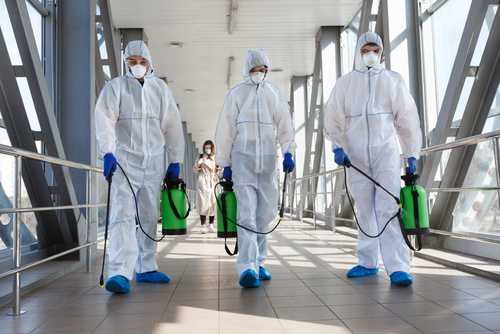
Professional teams use color-coded microfiber systems to prevent cross-contamination between zones, meaning the cloth used in a restroom is never the same one applied in a breakroom or office. They also employ electrostatic sprayers and UV-C light technology in some settings, allowing disinfectants to coat surfaces uniformly, including hard-to-reach undersides and crevices that manual wiping often misses.
For facilities that experience peak traffic during certain hours, such as corporate lobbies during morning and evening commutes, professional service providers can schedule targeted disinfection rounds during low-occupancy windows. This ensures that surfaces are treated at the most strategically effective times without disrupting daily operations or creating unnecessary exposure for occupants.
Workplace Sanitation Protocols That Meet Industry and Regulatory Standards
Compliance is a growing concern for facility managers, particularly in industries like healthcare, food service, education, and financial services. Regulatory bodies and insurance providers increasingly expect organizations to demonstrate that they follow documented, repeatable workplace sanitation protocols. Relying on informal or ad hoc cleaning schedules creates liability and leaves organizations vulnerable during audits, inspections, or in the aftermath of a reported illness cluster.
Professional office disinfection services provide more than just labor; they deliver documentation. After each service visit, reputable providers supply detailed logs that record which areas were treated, which products were used, and what concentrations and dwell times were applied. This paper trail is invaluable when facilities need to demonstrate due diligence to regulators, tenants, or corporate leadership.
Beyond documentation, professional providers stay current on evolving guidance from the CDC, OSHA, and local health departments. When new pathogens emerge or guidelines are updated, trained disinfection teams can adapt their protocols quickly, something that in-house staff without ongoing training are rarely positioned to do. For organizations seeking commercial cleaning services in Palo Alto or commercial cleaning services in San Jose, CA, working with locally based providers also means faster response times when urgent disinfection needs arise after a confirmed illness or environmental event.
Customized Disinfection Programs for Diverse Commercial Environments
No two commercial facilities are exactly alike. A tech startup with an open floor plan and hot-desking policies has entirely different sanitation needs than a multi-tenant office building, a fitness center, or a healthcare clinic. Effective commercial disinfection services are not one-size-fits-all; they are built around a thorough assessment of each facility’s layout, usage patterns, occupancy types, and risk factors.
During an initial consultation, professional providers typically conduct a facility walkthrough to identify high-risk zones, assess ventilation and air quality factors, and discuss the specific concerns of facility managers. From there, they develop a customized service plan that specifies the frequency of visits, the areas to be prioritized, the disinfectants to be used, and the application methods best suited for each space.
For example, a shared co-working space in downtown San Jose with dozens of rotating users each day may require daily high-touch surface disinfection combined with weekly deep cleaning of upholstered furniture and HVAC intake areas. A corporate headquarters in Palo Alto with a stable, known workforce may be adequately served by a structured bi-weekly deep disinfection program supplemented by daily restroom and breakroom sanitation. The flexibility of professional service providers to tailor these programs is one of the most significant advantages they offer over standardized, one-size-fits-all cleaning contracts.
The Long-Term Value of Investing in Professional Facility Sanitation Services
Some organizations hesitate to invest in professional disinfection out of a belief that their existing cleaning staff can handle the job. While general commercial cleaning services cover important daily maintenance tasks such as vacuuming, trash removal, and surface wiping, they are not a substitute for specialized disinfection programs. The cost of underinvesting in sanitation becomes apparent when absenteeism rises, when a preventable illness spreads through an office, or when a facility faces reputational damage following a public health incident.
Research consistently shows that healthier work environments lead to higher employee productivity, lower turnover, and fewer sick days. Businesses that prioritize professional sanitation send a clear message to their workforce and their clients: the health and safety of everyone who walks through the door is taken seriously. This is particularly relevant in competitive markets like Palo Alto and San Jose, CA, where top talent and sophisticated clients have high expectations for the quality and safety of the spaces they occupy.
Furthermore, routine professional disinfection can extend the lifespan of surfaces, fixtures, and shared equipment by preventing the buildup of contaminants that cause material degradation over time. When viewed through the lens of total facility management, the return on investment becomes compelling.
Conclusion
Protecting a high-traffic commercial facility from the risks associated with pathogen transmission requires more than good intentions and a mop. It demands structured, science-based workplace sanitation protocols carried out by trained professionals using EPA-approved disinfectants and proven application methods. From high-touch surface cleaning programs to fully customized facility sanitation services, professional providers bring the expertise, documentation, and adaptability that modern commercial environments require.
For organizations across the Bay Area looking for reliable commercial cleaning services in Palo Alto or commercial cleaning services in San Jose, CA, partnering with a professional disinfection provider is one of the most impactful investments a facility manager can make in the long-term health of both people and property.
Need Professional Janitorial Services Near You?
Empire Building Maintenance, Inc. is a professional cleaning company in Milpitas, CA. We offer high-quality commercial cleaning and decontamination services—our employees are professionally trained for commercial cleaning using the latest eco-friendly cleaning products. Additionally, we use a quality control team to ensure upper-echelon services. Contact us today to schedule our cleaning services!